Mechanical Thrombectomy: A Breakthrough in Acute Ischemic Stroke
Mechanical thrombectomy is one of the most important advances in modern stroke care. It is a minimally invasive, catheter-based procedure used to remove a blood clot from a blocked brain artery in patients with acute ischemic stroke, particularly those caused by large vessel occlusion (LVO). Stroke remains a leading cause of death and long-term disability worldwide. Rapid recognition and treatment are critical—because in stroke, time is brain.
What Happens in an Ischemic Stroke?
About 85% of strokes are ischemic, meaning they are caused by a blood clot blocking an artery that supplies the brain. When a major artery—such as the middle cerebral artery—is occluded, millions of neurons die every minute. Without restoration of blood flow, the damage becomes permanent.
For decades, the main treatment was intravenous thrombolysis (clot-busting medication such as alteplase). While effective in some patients, its ability to dissolve large clots is limited. Mechanical thrombectomy changed that.
What Is Mechanical Thrombectomy?
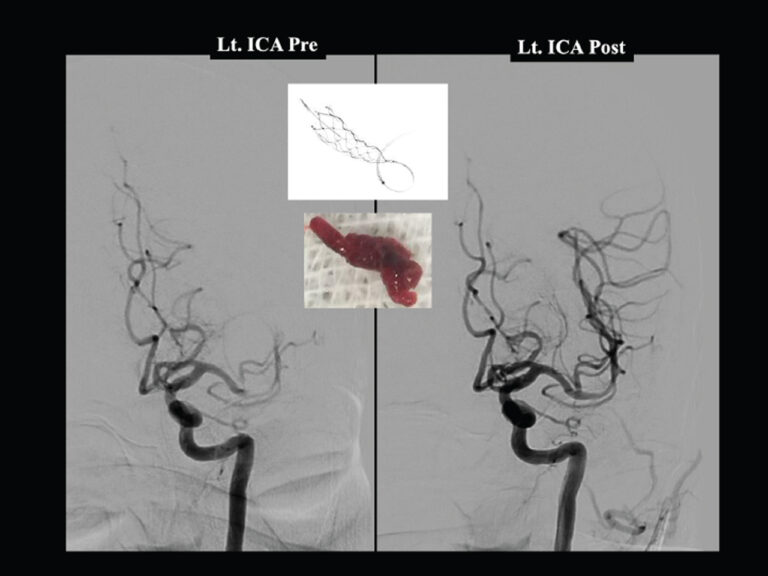
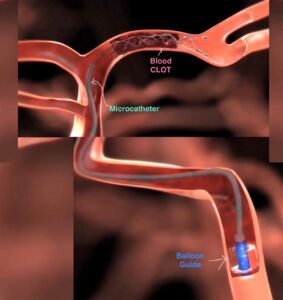
Mechanical thrombectomy involves navigating a thin catheter from an artery in the groin or wrist up to the blocked brain vessel under X-ray guidance. Devices such as stent retrievers or aspiration catheters physically remove the clot, restoring blood flow. The procedure is performed in specialized neurointerventional centers, ideally within a comprehensive stroke unit.
The Scientific Breakthrough: Landmark Trials
In 2015, five pivotal randomized controlled trials revolutionized stroke care:
- MR CLEAN (Netherlands)
- ESCAPE (Canada)
- EXTEND-IA (Australia)
- SWIFT PRIME (USA)
- REVASCAT (Spain)
These trials demonstrated that adding thrombectomy to standard medical therapy significantly improved functional outcomes in patients with large vessel occlusion treated within 6 hours of symptom onset. Across studies, the rate of functional independence (modified Rankin Scale 0–2 at 90 days) increased by approximately 13–31% compared to medical therapy alone.
A pooled meta-analysis (HERMES collaboration, 2016) showed that thrombectomy nearly doubled the likelihood of achieving independence. The number needed to treat (NNT) to reduce disability was approximately 2.6, remarkably effective in modern medicine.
Extending the Treatment Window
Initially, thrombectomy was limited to 6 hours. However, advanced imaging allowed selection of patients who still had salvageable brain tissue beyond this window.
Two transformative trials expanded eligibility:
- DAWN
- DEFUSE 3
These studies demonstrated that carefully selected patients could benefit from thrombectomy up to 16–24 hours after the last known well. This extended window has dramatically increased access to treatment worldwide.
Who Is Eligible?
Patients with:
- Sudden weakness, speech difficulty, facial droop, or vision loss
- Confirmed large vessel occlusion on CT angiography
- Favorable brain imaging (limited core infarct, salvageable penumbra)
Early arrival at a stroke-ready hospital is critical. Every 30-minute delay reduces the probability of a good outcome by nearly 10–15%.
Global Impact and Public Awareness
Mechanical thrombectomy has transformed stroke from a condition of inevitable disability to one that is frequently reversible—if treated rapidly. International guidelines from the American Heart Association and European Stroke Organization strongly recommend thrombectomy for eligible patients.
Despite robust scientific evidence, many regions still lack adequate access to comprehensive stroke centers. Public awareness of stroke symptoms using the FAST mnemonic (Face drooping, Arm weakness, Speech difficulty, Time to call emergency services) is essential.
Safety and Outcomes
Modern thrombectomy achieves successful recanalization (TICI 2b/3) in 80–90% of cases in experienced centers. Complication rates are low, and the procedure significantly reduces mortality and long-term disability compared with medical therapy alone.
The Future of Stroke Care
Ongoing research is focusing on:
- Medium vessel occlusions (MeVO trials)
- Ultra-early neuroprotection
- Artificial intelligence in imaging selection
- Mobile stroke units and direct-to-angiosuite strategies
As global stroke burden rises, mechanical thrombectomy represents one of the most powerful tools in acute neurovascular medicine.
Key Takeaway
Mechanical thrombectomy is a scientifically proven, life-saving treatment for acute ischemic stroke due to large vessel occlusion. Supported by landmark trials such as MR CLEAN, ESCAPE, DAWN, and DEFUSE 3, it dramatically improves survival and independence when performed rapidly in specialized centers. Public awareness and timely hospital access are the difference between lifelong disability and full recovery.
If stroke symptoms appear, seek emergency care immediately. Minutes matter.