Flow diverter therapy represents a major advancement in the treatment of complex brain aneurysms, offering a highly precise and minimally invasive alternative to traditional surgical approaches. At a specialised brain stroke centre, this state-of-the-art neurointerventional procedure is designed not just to treat aneurysms, but to address their root cause.
By redirecting blood flow away from the weakened area of the vessel, flow diverters promote natural healing and gradual reconstruction of the artery wall. This significantly reduces the risk of aneurysm rupture and helps prevent life-threatening hemorrhagic strokes. With improved safety, faster recovery times, and durable long-term outcomes, flow diverter therapy is transforming how challenging aneurysms are managed.
What Are Flow Diverters and How Do They Work?
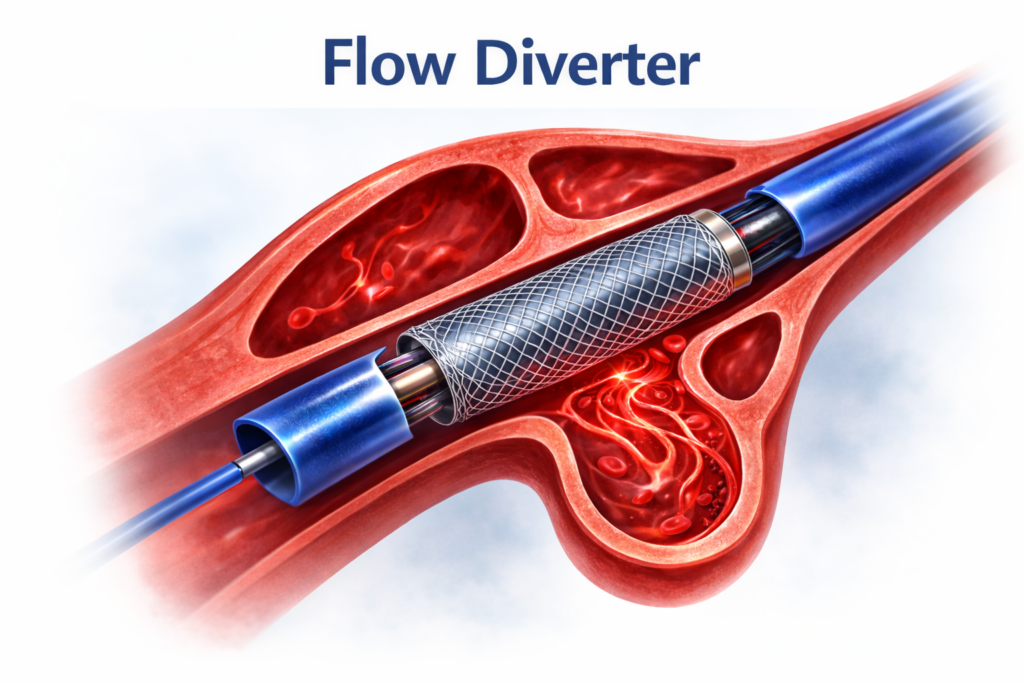
Flow diverters are biocompatible, specially designed stents placed inside brain arteries to divert blood away from weak points such as aneurysms. These devices are:
- Highly flexible
- Composed of tightly woven braided metallic wires (48–64 wires)
- Designed with high mesh density
- Providing 30–45% metal surface coverage
Mechanism of Action
- The stent is deployed across the aneurysm neck.
- Blood flow into the aneurysm sac is significantly reduced.
- Normal blood supply continues through side branches.
- Over 3 to 12 months, the aneurysm gradually shrinks and is completely obliterated.
- The parent artery reconstructs as endothelial tissue grows over the stent.
Indications for Flow Diverter Treatment
Flow diverters are recommended for aneurysms with specific morphological features:
Wide-Neck Saccular Aneurysms
- Neck > 4 mm
- Neck-to-dome ratio < 0.5
- Usually unruptured
Complex Aneurysms
- Fusiform aneurysms
- Dissecting aneurysms
- Blister aneurysms
- Irrespective of size
Select Ruptured Aneurysms
Not suitable for aneurysm coiling or surgical clipping
Types of Flow Diverters Available
Currently, multiple flow diverter devices are available in India:
- Pipeline (Medtronic, USA) – FDA approved
- Surpass (Stryker, USA) – FDA approved
- Silk Vista (BALT, Germany)
- FRED (Microvention, USA)
- Derivo (Acandis, Germany)
- p64 / p48 (Phenox, Germany)
Advanced Technologies Include:
- DFT technology for better fluoroscopic visibility
- HPC coating for reduced thrombogenicity (Pipeline Shield, p64 HPC)
- Small vessel compatibility (Silk Vista Baby, p48 HPC, FRED Jr)
- High metal density coverage (highest in Surpass)
How Flow Diverter Treatment Is Performed
Flow diverter placement is a minimally invasive endovascular procedure that typically requires a short hospital admission (2–3 days).
Procedure Details:
- Fasting for at least 6 hours before the procedure
- Performed under general anaesthesia
- Access through the femoral (groin) or radial (wrist) artery
- Duration approximately 2–3 hours
Procedure Steps:
- A small puncture is made in the artery.
- Catheters are navigated into the neck vessels.
- A microcatheter reaches the target brain artery.
- The flow diverter is deployed across the aneurysm.
Pre-Procedure Preparation and Follow-Up
Before the Procedure
- Dual antiplatelet therapy is administered at least 6 hours prior.
- These medications reduce the risk of in-stent clot formation.
After the Procedure
- Antiplatelet medications are continued for at least 1 year.
- Follow-up imaging is essential.
Imaging Follow-Up Schedule:
- CT Angiography or Digital Subtraction Angiography (DSA)
- At 3 months
- At 6 months
- At 12 months
Most aneurysms gradually obliterate within 3–12 months. Follow-up imaging ensures complete closure and guides medication adjustments.
Why Choose a Specialised Brain Stroke Centre?
Treatment outcomes in complex neurovascular conditions depend heavily on expertise and infrastructure. At an advanced brain stroke centre, patients benefit from:
- State-of-the-art imaging technology
- Experienced neurointervention specialists
- Comprehensive peri-procedural monitoring
- Structured long-term follow-up care
With guidance from an experienced brain stroke physician, Dr Nishant, flow diverter therapy offers a safe, minimally invasive, and highly effective solution for managing challenging brain aneurysms.
Conclusion
Flow diverters represent a transformative advancement in aneurysm treatment. By reconstructing arteries and reducing aneurysm rupture risk, this minimally invasive therapy provides durable, long-term protection against stroke.
If you are seeking expert aneurysm care at a trusted brain stroke centre, consultation with Dr Nishant, an experienced brain stroke physician, can help determine whether flow diverter treatment is the right solution for you.