Minimally Invasive Approach: The procedure is performed using a small catheter, eliminating the need for large surgical incisions.
Reduced Risk of Brain Hemorrhage: Blocking abnormal blood flow significantly reduces the risk of future brain hemorrhage.
Shorter Recovery Time: Children usually recover faster compared to traditional neurosurgical procedures.
Improved Treatment Outcomes: When performed by an experienced neurovascular specialist, embolisation can improve the effectiveness of treatments such as surgery or radiosurgery.

Pediatric AVM Embolisation Treatment for Brain AVM
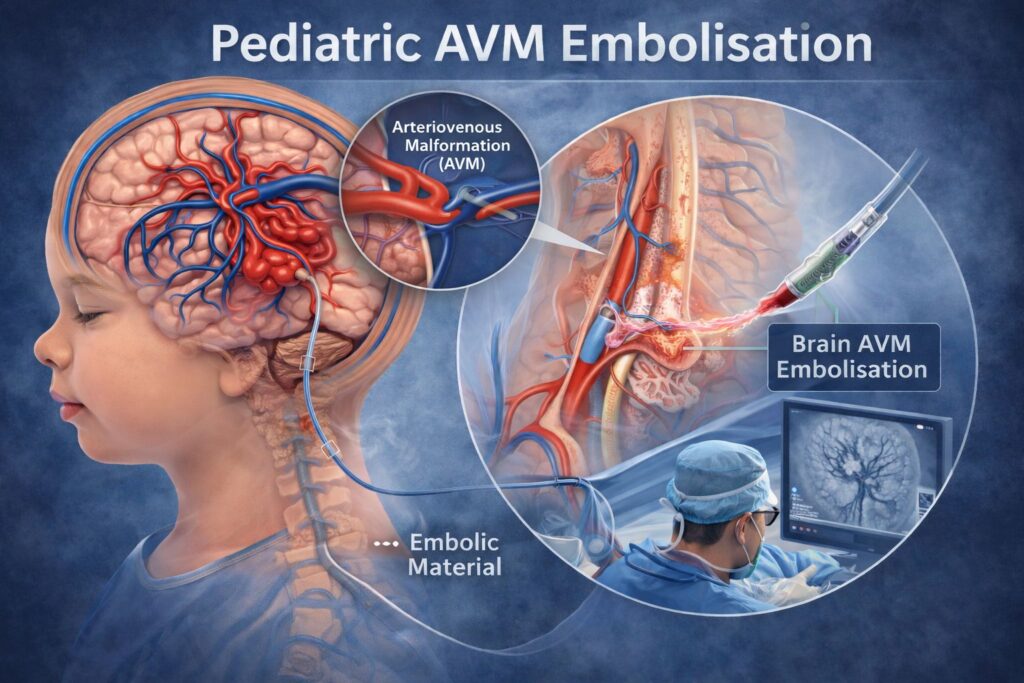
Pediatric arteriovenous malformations (AVMs) are rare but serious vascular conditions that can affect the brain of children. An AVM is an abnormal connection between arteries and veins that disrupts normal blood circulation. Because these vessels bypass the capillary system, blood flows rapidly and can increase the risk of bleeding in the brain. When untreated, this condition may lead to severe neurological complications, including a stroke.
Pediatric AVM embolisation is a minimally invasive procedure used to treat or manage arteriovenous malformations (AVMs) in the brain of children. This technique, also known as brain AVM embolisation, involves guiding a thin catheter through the blood vessels to reach the abnormal connection, where special materials are injected to block or reduce blood flow. By targeting the affected vessels, the procedure helps lower the risk of brain bleeding and other complications while supporting better long-term neurological outcomes. Early diagnosis and timely treatment play an important role in improving recovery and overall health.
What Is a Pediatric Brain AVM?
A brain AVM is a congenital condition, meaning it usually develops before birth. In children with AVMs, arteries connect directly to veins without the normal network of tiny blood vessels called capillaries. This abnormal structure creates elevated venous pressure, making the veins fragile and prone to rupture.
Symptoms of pediatric AVMs can vary depending on the location and size of the malformation. Some children may remain asymptomatic for years, while others may experience sudden neurological symptoms.
Common symptoms include:
Severe or recurring headaches
Seizures
Weakness in the arms or legs
Difficulty speaking or understanding speech
Vision problems
Sudden brain hemorrhage or stroke
If any of these symptoms appear, evaluation at a stroke centre is critical for proper diagnosis and treatment planning.
What Is Pediatric AVM Embolisation?
Pediatric AVM embolisation is an advanced endovascular procedure designed to block or reduce blood flow to the abnormal vessels. The procedure is performed using imaging guidance and specialized microcatheters.
During embolisation, an endovascular neurosurgeon inserts a thin catheter through a blood vessel, usually from the groin or wrist. The catheter is carefully guided through the vascular system to reach the AVM in the brain.
Once positioned, the doctor injects embolic materials such as:
Medical glue
Onyx liquid embolic agent
Tiny coils or particles
These materials block the abnormal vessels and reduce blood flow through the AVM, lowering the risk of bleeding.
When Is Pediatric AVM Embolisation Recommended?
Not all AVMs require the same treatment approach. Pediatric AVM embolisation may be recommended in the following situations:
To reduce the size of the AVM before surgery
To control bleeding risk
As a primary treatment for certain AVMs
To treat residual AVM after surgery or radiosurgery
Benefits of Pediatric AVM Embolisation
Compared to open brain surgery, embolisation offers several advantages for pediatric patients.
How the Procedure Is Performed
Pediatric AVM embolisation is typically performed in a specialized neurointerventional suite.
Step 1: Pre-Procedure Imaging – Advanced imaging tests such as CT scans, MRI, and cerebral angiography help identify the exact structure and location of the AVM.
Step 2: Catheter Navigation – A microcatheter is inserted into a blood vessel and guided toward the AVM under real-time imaging.
Step 3: Delivery of Embolic Agent – The embolic material is injected into the abnormal vessels to block blood flow.
Step 4: Post-Procedure Monitoring – After the procedure, the child is closely monitored to ensure the absence of complications.
The entire procedure may take several hours, depending on the complexity of the AVM.
Recovery After Pediatric AVM Embolisation
Most children remain in the hospital for observation for one to two days after the procedure. Recovery is usually smooth, and children can gradually return to normal activities under a physician’s guidance.
Follow-up visits with the stroke physician are important for monitoring progress and evaluating whether additional treatments are necessary. Long-term imaging may also be recommended to confirm successful treatment of the AVM.
Why Early Treatment Matters
Pediatric brain AVMs carry a significant risk of bleeding over time. Early diagnosis and treatment help prevent life-threatening complications such as intracranial hemorrhage and stroke.
Specialized treatment at a brain stroke centre ensures access to advanced imaging, neurointerventional expertise, and comprehensive stroke care for children. With the right treatment approach, many pediatric patients can achieve excellent outcomes and lead healthy lives.
If your child has been diagnosed with a brain AVM or shows symptoms of neurological distress, consulting an experienced brain stroke physician is crucial. Early evaluation and advanced treatments such as pediatric AVM embolisation can significantly reduce the risk of stroke and improve long-term neurological health.
- 022-61305089
- drnishant@stroketreatment.in
- nishantaditya@yahoo.com