Minimally Invasive Brain Aneurysm Coiling Treatment
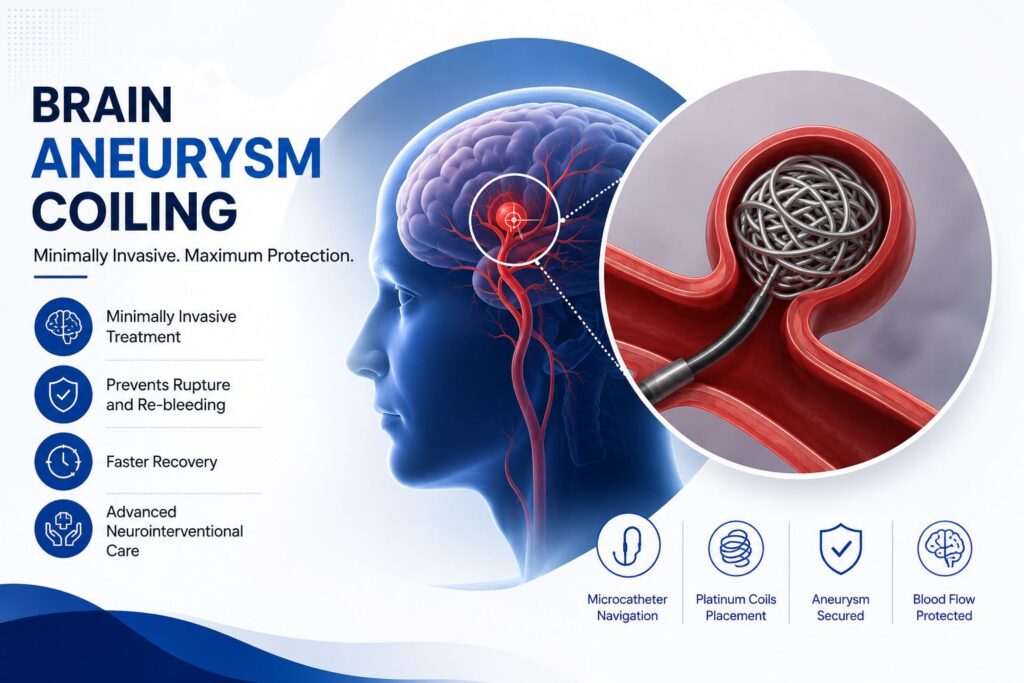
Advanced Minimally Invasive Treatment for Brain Aneurysm
Brain aneurysm coiling is an advanced minimally invasive neurointerventional procedure used to treat brain aneurysms and reduce the risk of life-threatening brain hemorrhage. At our specialised brain stroke centre, aneurysm coiling is performed using modern endovascular techniques without opening the skull, helping patients recover faster with lower surgical risk.
A brain aneurysm is a weak, balloon-like swelling in a brain artery. If the aneurysm ruptures, it can cause bleeding around the brain known as subarachnoid hemorrhage (SAH), which is a serious neurological emergency requiring immediate treatment. Brain aneurysm coiling helps seal the aneurysm from inside the blood vessel and prevents rupture or re-bleeding.
At StrokeTreatment.in, Dr. Nishant Aditya, an experienced brain stroke physician, performs advanced aneurysm coiling procedures using state-of-the-art neurovascular imaging and interventional neuroradiology techniques.
What Is Brain Aneurysm Coiling?
Brain aneurysm coiling is a minimally invasive endovascular procedure in which tiny platinum coils are inserted into the aneurysm through a microcatheter. These coils promote clot formation inside the aneurysm and block blood flow into the weak area of the artery.
The procedure is performed through a small puncture in the groin or wrist artery without opening the skull.
Aneurysm coiling is commonly used for:
- Ruptured brain aneurysms
- Unruptured aneurysms at high risk of rupture
- Wide-neck aneurysms
- Complex aneurysms unsuitable for surgery
- Patients requiring minimally invasive treatment
Symptoms of Brain Aneurysm
Many brain aneurysms remain silent until they enlarge or rupture. Symptoms may include:
- Sudden severe headache
- Loss of consciousness
- Vomiting
- Blurred or double vision
- Neck stiffness
- Weakness or paralysis
- Seizures
- Difficulty speaking
- Sudden neurological deficit
A ruptured aneurysm is a medical emergency and requires immediate treatment at a specialised brain stroke centre.
Causes and Risk Factors for Brain Aneurysm
Several factors can increase the risk of brain aneurysm formation and rupture:
- High blood pressure
- Smoking
- Family history of aneurysm
- Increasing age
- Connective tissue disorders
- Brain artery abnormalities
- Excessive alcohol consumption
Early diagnosis and treatment can significantly reduce the risk of brain hemorrhage and stroke.
How Brain Aneurysm Coiling Is Performed
Brain aneurysm coiling is performed in a specialised neurointerventional cath lab under advanced imaging guidance.
Procedure Steps
- A small catheter is inserted through the femoral artery (groin) or radial artery (wrist).
- The catheter is carefully navigated into the brain’s blood vessels.
- A microcatheter is advanced into the aneurysm sac.
- Soft platinum coils are deployed into the aneurysm.
- The coils fill the aneurysm and reduce blood flow inside it.
- In selected cases, balloon-assisted or stent-assisted coiling may be used for better support.
The procedure usually takes 1 to 3 hours depending on aneurysm complexity. Advanced neurovascular procedures such as flow diverter treatment may also be recommended in complex aneurysms.
Types of Aneurysm Coiling Techniques
Simple Coiling
Used for narrow-neck aneurysms where coils can be safely placed inside the aneurysm.
Balloon-Assisted Coiling
A temporary balloon supports coil placement in wide-neck aneurysms.
Stent-Assisted Coiling
A stent is placed across the aneurysm neck to support coil stability and preserve normal blood flow.
Flow Diversion
In complex aneurysms, flow diverter stents may be recommended to reconstruct the artery and reduce blood flow into the aneurysm.
Advantages of Brain Aneurysm Coiling
Compared to open brain surgery, aneurysm coiling offers several benefits:
- Minimally invasive procedure
- No skull opening
- Reduced recovery time
- Lower surgical trauma
- Shorter hospital stay
- Reduced risk of complications
- Faster return to daily activities
Most patients recover significantly faster compared to traditional aneurysm clipping surgery.
Recovery After Brain Aneurysm Coiling
Recovery depends on whether the aneurysm was ruptured or unruptured before treatment.
After the Procedure
- Patients are monitored in the ICU or neurocritical care
- Hospital stay is usually 2 to 5 days
- Mild headache or groin discomfort may occur temporarily
- Follow-up imaging is important to monitor aneurysm closure
Most patients can gradually resume normal activities within a few weeks, depending on their overall neurological condition.
Who Needs Brain Aneurysm Coiling?
Brain aneurysm coiling may be recommended for patients with:
- Ruptured aneurysm causing brain hemorrhage
- Large aneurysms
- Wide-neck aneurysms
- Symptomatic aneurysms
- High-risk unruptured aneurysms
- Patients unsuitable for open surgery
Treatment decisions depend on aneurysm size, location, shape, age, and overall health condition. Early consultation with a qualified brain stroke physician is important for proper neurovascular evaluation.
Why Choose Our Brain Stroke Centre?
At StrokeTreatment.in, we provide advanced neurovascular and stroke care with a focus on rapid diagnosis and minimally invasive treatment.
Our Brain Stroke Centre offers:
- Advanced neurointerventional procedures
- Modern cath lab and imaging technology
- Expertise in complex brain aneurysm treatment
- Emergency stroke and hemorrhage management
- Personalised patient care
- Comprehensive neurovascular evaluation
Dr. Nishant Aditya specialises in interventional neuroradiology procedures for stroke, aneurysm, AVM, and complex neurovascular disorders, including mechanical thrombectomy, dural sinus stenting, and advanced stroke interventions.
Is brain aneurysm coiling a surgery?
How long does aneurysm coiling take?
Can a brain aneurysm return after coiling?
What is better, clipping or coiling?
- 022-61305089
- drnishant@stroketreatment.in
- nishantaditya@yahoo.com